

Self Driving Car Accidents Attorney Indianapolis
 When a self-driving vehicle is involved in a motor vehicle accident, the consequences for the victims are often severe. Beyond the physical injuries, they face a wall of uncertainty. Traditional car accident claims hinge on proving the negligence of a human driver.
Autonomous vehicle crashes are relatively new, however. Car accident lawyers and insurance companies don’t have decades of this technology on the road to inform decision making. As a result, the scope of liability is broadened to include the powerful corporations that designed, built, and sold the technology. Proving liability and securing financial compensation requires a sophisticated investigation into electronic data, sensor logs, and proprietary algorithms—evidence that is often difficult and expensive to obtain and analyze.
Your Indiana Car Accident Attorneys
At Crossen Law Firm, we are committed to demystifying this process and making it easier for victims to win compensation.
Contact us today by calling 317-939-6800 to schedule a free consultation. When you are looking for a self driving car accident lawyer in Indianapolis, your search is over. We understand the challenges you face and are here to offer compassionate support and dedicated legal counsel so you receive the financial compensation you deserve.
Our Indianapolis car accident attorneys are well-versed in the tactics insurance companies employ to minimize their payouts. We are prepared to counter them at every stage of your car accident case and seek compensation for life-changing serious injuries or wrongful death
What Are Self-Driving Cars?
 A self-driving car, or autonomous vehicle (AV), is a vehicle that utilizes a complex network of sensors, cameras, radar, and artificial intelligence (AI) to navigate its environment with reduced human input.
The ultimate vision is a car that can handle all driving responsibilities from start to finish. However, the technology currently available on public roads exists on a spectrum. This spectrum is formally defined by the Society of Automotive Engineers (SAE), whose classification system is now the industry and legal standard.
Understanding a vehicle’s specific level of automation is not merely a technicality; it is a critical legal distinction in any personal injury case. The level of automation dictates the expected responsibilities of the human driver and directly informs the legal strategy for determining fault.
As these vehicles become more prevalent in Indianapolis, the traffic accidents they are involved in will continue to test the limits of our existing legal frameworks. A proficient car accident lawyer must be well-versed in these technological nuances to effectively represent a client injured in such a crash.
Levels of Automation
To properly assign liability after a self-driving car accident, a legal team must analyze the vehicle’s capabilities through the SAE’s six levels of automation. This framework is essential for determining how much responsibility fell on the human driver versus the car. Any Indianapolis car accident lawyer knows investigation and negotiation with the insurance company involving this technology begins here.
Level 0: “No Driver Automation,” The human driver is solely responsible for 100% of the driving tasks such as steering, braking, and accelerating. The vehicle may have warning systems, like a blind spot alert, but it cannot actively control itself. In a Level 0 car accident, liability analysis is traditional and focuses exclusively on driver error.
Level 1: “Driver Assistance,” means the vehicle’s system can assist with either steering or speed control, but not both simultaneously. Adaptive cruise control is a common example. The driver remains responsible for all other aspects of driving and must be fully engaged. Fault in a crash almost always rests with the driver, though a system malfunction could introduce a product liability question.
Level 2: “Partial Driving Automation,” is the most common form of “self-driving” technology on the road today. These systems can control both steering and speed at the same time. However, it does not have full autonomy. The driver is required to remain vigilant, monitor the environment, and be prepared to take over instantly.
Car crashes at this level create complex legal battles, with manufacturers blaming driver inattention and the victim’s Indianapolis car accident lawyer pointing to system failures or misleading marketing.
Level 3: “Conditional Driving Automation,” means that under specific, limited conditions (like clear weather on a highway), the car can manage all driving tasks, allowing the driver to disengage. The critical caveat is that the driver must be ready to retake control when the system requests it.
This “hand-off” period is a major point of concern. If a car accident occurs because the driver was not given enough time to respond to a prompt, liability may shift to the manufacturer. This is a key area of dispute in a personal injury lawsuit.
Level 4: “High Driving Automation,” is defined as the vehicle being able to perform all driving functions without any expectation of human intervention, but only within a limited, defined area or set of conditions known as its Operational Design Domain (ODD). Outside of this ODD, it cannot drive itself.
If an auto accident occurs while the system is operating within its intended domain, liability is very likely to fall on the manufacturer or technology developer, making this a clear product liability case.
Level 5: “Full Driving Automation,” is the ultimate goal—a vehicle that can operate on any road and under all conditions without a human driver. No steering wheel or pedals are necessary. In a Level 5 auto accident, the system itself is the driver. Therefore, liability would almost certainly rest with the entities that designed, built, and programmed the vehicle.
These automobile accidents require a formidable car accident law firm to navigate these new legal precedents.
Features That Define Self-Driving Cars
 The functionality of an autonomous vehicle depends on the seamless integration of three types of technology. A failure or limitation in any one of these core components can lead to a serious car accident. A thorough investigation must analyze the performance of each system to identify the root cause of the crash, as well as the potential medical bills incurred .
Artificial Intelligence (AI)
The AI is the vehicle’s brain. It uses machine learning to process immense amounts of data from sensors, interpret the surrounding environment, and make decisions about how to navigate.
An error in the AI’s programming or its interpretation of a novel situation—like failing to recognize a pedestrian pushing a stroller—can directly cause a collision. Analyzing the AI’s decision-making in the moments before a crash is a key part of the legal process for these accident claims.
Mapping
Autonomous cars use highly detailed 3D maps that are far more advanced than consumer GPS. These maps contain precise data on lane positions, traffic signals, curb heights, and more. The vehicle uses this map to orient itself and anticipate road features.
If the map data is outdated or inaccurate—for example, it doesn’t show a new work zone—the vehicle can make a critical driving error based on false information. The mapping company could then share in the liability.
Sensors
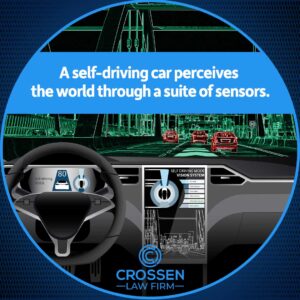
A self-driving car perceives the world through a suite of sensors. These include cameras for visual recognition, radar for detecting the speed and distance of objects (especially in bad weather), and Lidar, which uses laser pulses to create a detailed 3D image of the surroundings.
A failure of any sensor, whether from a malfunction, a software bug, or even an obstruction like mud or ice, can create a blind spot that leads directly to car crashes.
DOT Self-Driving Car Guidelines
 The U.S. Department of Transportation (DOT) and the National Highway Traffic Safety Administration (NHTSA) establish safety standards and guidelines for autonomous vehicles. While many of these guidelines, outlined in documents like “Automated Driving Systems: A Vision for Safety,” are currently voluntary, they create an important benchmark for insurance companies and the auto industry itself to follow.
They encourage manufacturers to conduct and publish extensive safety self-assessments, covering everything from system design and data recording to cybersecurity and consumer education.
Staying current with the complex interplay between federal guidelines and Indiana law is crucial. An Indiana car accident lawyer must have this dual expertise to effectively hold all negligent parties accountable after a crash.
Why Self-Driving Car Accidents Are More Complicated
A typical car accident investigation focuses on driver error. Was someone speeding, texting, or impaired? The evidence is usually straightforward: witness statements, police reports, and physical damage. A self-driving car accident, however, transforms the investigation. The focus shifts from simple driver negligence to the much more complex area of product liability law.
The central question becomes: “What part of the product failed?” This inherent complexity is the single most important reason victims need an experienced Indianapolis car accident lawyer.
These cases require significant financial resources to depose engineers, analyze code, and present complex technical arguments to a jury. Insurance companies for multi-billion dollar automakers have a deep bench of lawyers and experts. You need a veteran Indianapolis car accident attorney with the resources and experience to match them.
Three Types of Common Self-Driving Car Accidents
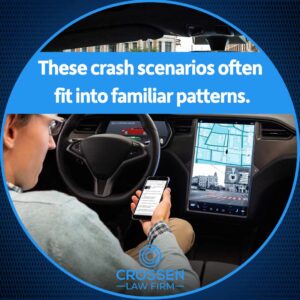 Self-driving car accident cases are new because the technology is new. These crash scenarios often fit into familiar patterns, but the underlying cause of the car accident is what makes each scenario legally distinct.
Driver and Self
This is a single-vehicle crash where the autonomous car hits a stationary object like a guardrail or a parked vehicle. In a normal car, this is almost always the driver’s fault. But here, the car’s navigation or sensor system could be to blame.
Driver and Property
In this instance, the self-driving car causes damage to property, such as running into a fence or a garage. While there may be no physical injuries, the property owner is still entitled to compensation. The legal fight would again be centered on whether a human or a system error was the cause, determining who is financially responsible for the repairs.
Driver vs. Driver
This involves a collision with another vehicle and is the most common and complex scenario. A self-driving car might rear-end someone, while making an unsafe lane change, or failing to yield at an intersection.
It is possible for both a human driver and the autonomous system to share blame, leading to a contentious battle between their respective insurance companies. An expert Indianapolis car accident lawyer is needed to sort through the facts.
What Can Cause a Self-Driving Car Accident
 While autonomous systems are designed to eliminate human error, they introduce new and unique points of failure. Identifying the specific cause of the collision is the most critical task for your attorney in building a successful personal injury claim. The causes often fall into one of these categories:
Software Failure – A bug in the complex code or a flaw in the AI’s decision-making algorithm can cause the car to behave erratically.
Sensor Malfunction or Limitation- A camera blinded by sun glare, radar confused by a bridge, or a Lidar sensor obscured by dirt can leave the vehicle blind to its surroundings.
Human Error – This remains a key factor, especially in Level 2 and 3 vehicles where a driver’s inattention or overreliance on the system contributes to the car accident.
Injuries to Victims of Self-Driving Car Accidents
The injuries sustained in a self-driving car accident can be just as severe and life-altering as in any high-speed collision. The forces involved can cause serious injuries, leading to a lifetime of medical challenges for the injured parties. Seeking immediate medical treatment for your severe injuries is the first priority, followed by consulting an Indiana personal injury lawyer to protect your rights.
Head and Brain
The violent motion of a crash can cause the head to whip back and forth or strike the interior of the car, leading to concussions or more severe traumatic brain injuries (TBI). A TBI can permanently affect a person’s cognitive abilities, memory, and personality.
The symptoms of brain injuries can be subtle at first and develop over time, which is why a full medical evaluation is essential. Documenting the injuries a car accident caused through medical records is critical in a personal injury case.
Back and Neck
 Back and neck injuries are extremely common in car crashes. Whiplash, a form of soft tissue injury, can cause chronic pain. More forceful impacts can lead to herniated discs, fractured vertebrae, and catastrophic spinal cord injuries.
An injury to the spinal cord can result in paralysis, requiring a lifetime of care and mobility assistance. The cost of this care is a major component of any injury claim.
Internal
The blunt force of a collision can cause severe internal injuries, such as organ damage or internal bleeding, which are life-threatening medical emergencies. These injuries require immediate surgery and lengthy hospitalizations to treat, leading to overwhelming medical bills. Your car accident attorney will work to ensure these medical expenses are fully covered in your claim.
Emotional
The trauma from a car accident is not only physical. Many victims suffer from significant psychological harm, including post-traumatic stress disorder (PTSD), severe anxiety, and a debilitating fear of driving.
Emotional distress is a very real and compensable injury. An experienced Indianapolis car accident lawyer knows how to document this suffering to ensure you receive fair compensation for all aspects of your harm.
Documenting the Scene of a Self-Driving Car Accident
Any auto accident attorney will tell you the actions you take immediately following a self-driving car accident can significantly impact the outcome of your case. But what else should you do to make sure your accident is reflected properly in your personal injury claim? If you are able, it is critical to gather evidence to support your case.
First, ensure everyone is safe and call 911 to request police and medical assistance. Always get a formal police accident report, and make sure to tell the officer that an autonomous vehicle was involved. Exchange driver’s licenses, contact details, and insurance information with the other party. Use your smartphone to take photos and videos of the vehicle damage, the wider accident scene, road conditions, and any visible injuries.
If there are witnesses, get their names and contact information. Finally, and most importantly, seek a full medical evaluation from a doctor, even if you don’t feel seriously hurt. This creates a crucial record of your injuries for your car accident claim.
Saving medical records and treatment documents are crucial. An experienced auto accident attorney at Crossen Law Firm, will know which documents tend to fall through the cracks, causing a weak point in an accident case that insurance companies are sure to notice.
Liable Parties in a Self-Driving Car Accident
 Unlike a standard auto accident, a crash involving autonomous technology can have numerous liable parties. A skilled auto accident attorney will conduct a thorough investigation to identify every person or entity that shares blame for your injuries, which is essential for obtaining full compensation in personal injury suits.
Driver – In vehicles that require human oversight (Levels 2 and 3), the driver can still be held liable if they were guilty of distracted driving, were inattentive, or failed to retake control when necessary. Their negligence can be a contributing factor to the car accident. Their own insurance company is often the first place to file a claim.
Car and Parts Manufacturer – If the crash was caused by a defect in the car’s design, a manufacturing flaw, or a faulty component (like a sensor or brake system), the manufacturer can be held strictly liable under product liability law. This includes both the primary automaker and the companies that supplied the individual defective parts.
Software Companies – Software and AI are the heart of an autonomous system. If a software bug, a flawed algorithm, or a glitch in an update caused the crash, the company that developed that software can be held responsible for the resulting harm. This often requires hiring a software expert to analyze the code.
Distribution Chain – Other entities in the chain of commerce could also be liable. This might include a dealership that sold the vehicle without properly explaining its limitations or one that performed a faulty repair or software update. Every link in the chain must be investigated by your Indianapolis car accident law firm.
Damages You Can Include in a Self-Driving Car Accident Claim
Under Indiana law, victims of a car accident are entitled to seek compensation for all of their losses. The goal is to secure a settlement or verdict that covers every aspect of your damages, both present and future. An experienced car accident lawyer will meticulously calculate these losses, including medical bills, to ensure your demand for compensation is complete. These damages could include:
Economic Damages: These are your tangible financial losses. They cover all past and future medical expenses related to your medical treatment, all lost income from being unable to work, and compensation for any diminished future earning capacity. It also includes the cost of repairing or replacing your property.
Non-Economic Damages: These compensate you for the intangible, but profound, human losses. This includes payment for your physical pain and suffering, emotional distress and trauma, loss of enjoyment of life, disfigurement, and the loss of companionship suffered by a spouse.
Securing full compensation is essential in providing the financial stability you need to move forward.
When To Settle and When To Go to Court
The vast majority of accident claims are resolved through a negotiated settlement between your Indianapolis car accident attorney and the insurance companies. A settlement provides a certain and timely outcome, avoiding the stress and risk of a trial. Your attorney’s job is to build such a powerful case that the insurance company is compelled to offer a fair settlement that covers all your damages.
Sometimes a trial is necessary when the insurance company refuses to negotiate a fair settlement in good faith or if a key issue of liability is in dispute—which is common in complex self-driving car cases—taking your case to a jury may be the only path toward justice. A top car accident lawyer prepares every case from day one as if it is going to trial.
Current Legal Challenges for Self-driving Car Accident Cases
 The law is still racing to catch up with autonomous technology, creating a uniquely challenging legal landscape for victims. Two aspects of this new frontier are insurance claims and anticipating future laws.
Insurance Claims
The claims process is often a frustrating battle of finger-pointing. The driver’s insurer, the manufacturer’s insurer, and the software company’s insurer may all deny responsibility, each blaming the other for the car accident. An attorney is needed to break this stalemate and force the insurance claims to move forward.
Predicting Future Law
The rules governing autonomous vehicles are constantly changing at both the state and federal levels. New laws and court rulings can alter legal strategies overnight. A proactive law firm must stay on the cutting edge of these developments to best position your case for success, both today and in the future.
Crossen Law Firm: Fighting for You
 The promise of self-driving cars is bright, but the technology is not yet perfect. Insurance providers, insurance adjusters, and lawmakers alike are looking at how these crashes occur. After all, when accidents happen, the consequences for victims can be devastating. Navigating the legal aftermath requires more than just a general personal injury attorney; it requires a specialist who understands the technology, the industry, and the evolving laws.
Contact us today by calling 317-939-6800 to schedule a free consultation with an attorney who understands self-driving car accidents and the legal process involved. Injuries are difficult enough to manage during the insurance claims process. Together, we advocate for your right to fair compensation for your injury claim.
At Crossen Law Firm, we understand the challenges you face and are here to offer compassionate support and dedicated legal counsel so you do not have to face opposing insurance companies alone. Don’t hesitate to seek assistance after a fatal or non-fatal self-driving car accident incident in Indiana.

-
“Trevor was courteous, professional, fair, and an excellent communicator throughout our entire interaction! Would highly recommend.”
- Hussain -
“What a relief it was that we had someone like Trevor Crossen on our side. Everyone in the office were very pleasant and helpful. We would have been lost if not for him. This is a group that you need to be there when you have to fight for what is right. Automobile accidents are hard enough on you without having to have someone see you through all the paperwork and legal issues. There is no one else I would trust to take us through than Crossen Law Firm they are the best!”
- Bob Taylor -
“Mr. Trevor Crossen has been sìuch a blessing. I was so lost when we first met. He took great care to make sure that I was treated with dignity, he walked me through the whole process from beginning to the end. I had no idea what to expect but he took the time to explain everything and made sure I was treated the way I should be. I would highly recommend Trevor to anyone. The others in the office were so kind and helpful. If you want someone truly on your side Trevor Crossen is the man you need. Thank you all for being there for me.”
- Denise Taylor -
“I honestly don’t know where to start! Trevor is an exceptionable person, he honestly cares for those he works with and his clients! He has completely changed my mind of how lawyers act! He is a man of integrity and I, especially today on thanksgiving, am thankful I chose his law firm to represent me! I highly recommend that you choose Crossen law firm!! Thank you Trevor for all that you’ve done for me and continue to do!”
- Ben Steiner -
“Trevor and His Team Were a "True Guiding Light" for MY Family & I During a Very Difficult and Emotional Time in Our Lives! Thank You Team Crossen”
- Joe A
Why Crossen Law Firm?
Call our office today at (317) 939-6800 to discuss your case.